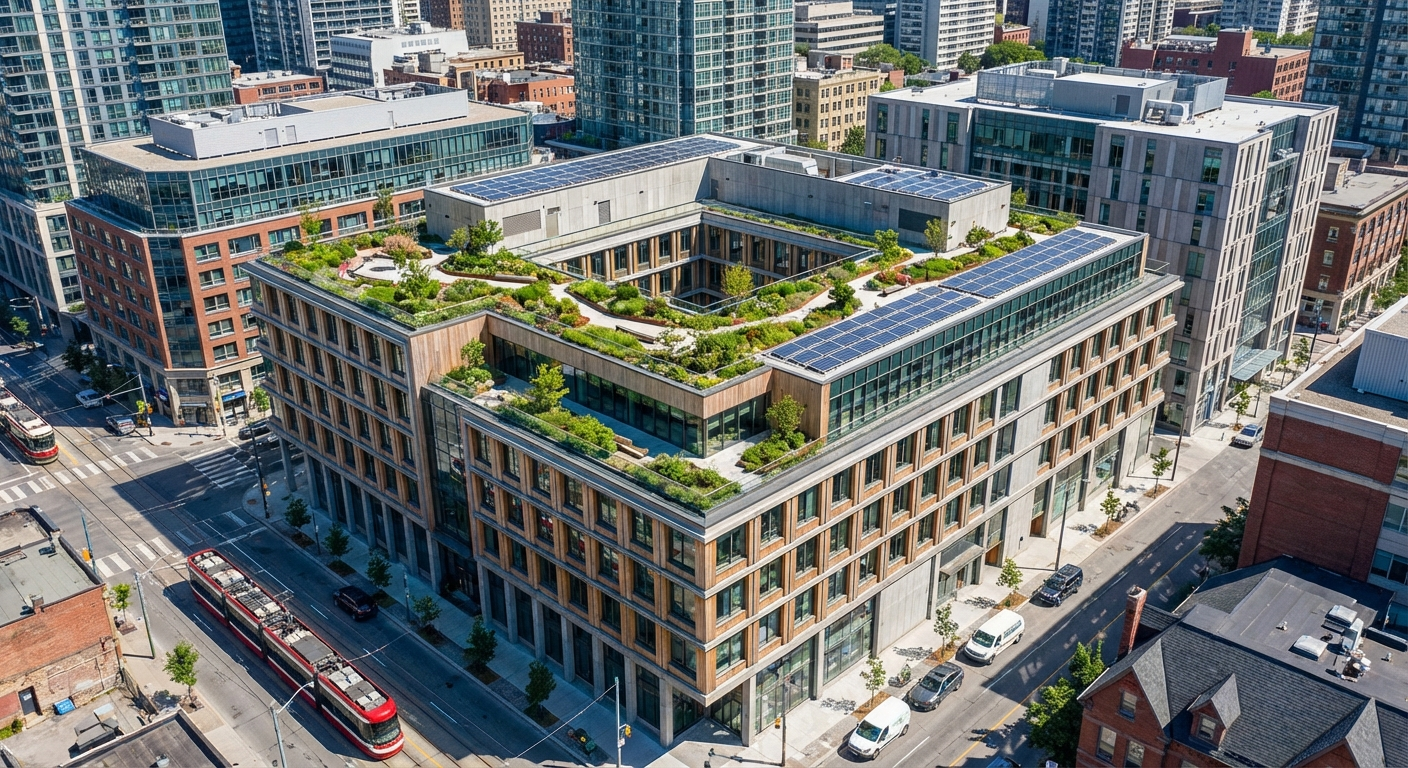
Until recently, having sustainable practices was a competitive advantage for real estate developers. Something that embellished sales materials, attracted a specific niche of buyers, and occasionally earned a few lines in press coverage. Today, it has become a requirement. And not just a market requirement—it's a prerequisite for accessing capital, closing corporate contracts, and soon, for obtaining financing under competitive conditions.
What happened between yesterday's "competitive advantage" and today's "strategic obligation" was not a gradual change. It was a convergence of forces: institutional investors redefining allocation criteria, more informed consumers demanding transparency, and now the Brazilian government creating a regulatory framework that will separate those who are aligned from those who have fallen behind.
This article analyzes the new ESG landscape in the Brazilian real estate market, with updated data and practical implications for developers who need to make decisions now.
The landscape has changed: ESG is now a prerequisite
Brazil recorded a record number of developments with sustainable certification in 2024, according to GBC Brasil (Green Building Council). More than 280 new projects were registered under certifications promoted by the organization alone—the highest number in history. But this record needs to be read in context to reveal its true meaning.
We're not talking about incremental growth. The green certification movement in Brazil has scaled over the past five years in a way that surprised even industry specialists. To understand the magnitude, it's worth stepping back: in 2022, GBC Brasil had already celebrated a historic record of registrations. In 2023, it surpassed that number. In 2024, it broke the record again. Three consecutive records are not coincidence—they're a sign of structural change.
The most revealing data point, however, is not about volume: it's about the level of excellence that Brazilian projects have achieved. According to the GBC Brasil 2024 Yearbook, while only 8% of developments worldwide achieve the Platinum certification level—the highest tier of recognition—in Brazil that number reaches 13%. Over the past three years, about 25% of Brazilian certifications reached the maximum level.
This disproportionately high performance relative to the global average raises an obvious question: why is Brazil performing so far above the curve?
According to Felipe Augusto Faria, CEO of GBC Brasil, the answer isn't where most people imagine: "The reason isn't tied to higher investment for certification levels, but rather smarter investment during the design phase."
This observation is crucial for developers who still associate sustainability with additional cost. The Brazilian experience demonstrates that you don't need to spend more to achieve higher certification levels. You need to plan better. The intelligence applied at the drawing board—before the first brick is laid—determines whether the development will have mediocre or exceptional sustainability performance.
Brazil also made history in 2024 by achieving the world's first LEED v5 project: the Portobello Jardim Social store in Curitiba. According to data from the U.S. Green Building Council, published by ESG Inside, the project obtained certification through the LEED v5 beta program for operations and maintenance, achieving zero on-site combustion, 88% renewable energy procurement, and a 90% improvement in emissions from building energy use. The country ranks 9th globally in total certified area—and leads in number of projects in Latin America.
Investors no longer accept developments without ESG criteria
The pressure for ESG practices in real estate didn't emerge from abstract environmental concern. It emerged from concrete financial logic: global asset managers realized that inefficient buildings represent risk. Obsolescence risk, vacancy risk, devaluation risk. And when large funds start pricing risk in a certain way, the entire market reorganizes.
According to a report from InfoMoney, real estate funds that don't adopt ESG criteria will face capital flight from institutional investors—those who move the largest volumes of resources. This isn't about ideological preference. It's risk management. Pension funds, insurers, and family offices have fiduciary mandates that require considering long-term risks. And climate change, along with the energy transition, is at the top of that list.
According to data from B3 (Brazil's stock exchange) published by Jornal do Commercio, institutional investors accounted for 35.8% of trading volume in Real Estate Investment Trusts (FIIs) in 2025. More than a third of all FII trading volume comes from investors who have ESG criteria as part of their decision-making process. This audience demands transparency in data disclosure, proven energy efficiency, and solid governance. Developments that cannot demonstrate these characteristics are excluded.
The global capital flow confirms the trend. A report from Jefferies cited by Exame magazine showed that in the second quarter of 2025, global sustainable assets under management grew 11% compared to the previous quarter. This isn't a short-term fluctuation—it's the continuation of a capital migration that has been accelerating since the pandemic.
For Brazilian developers, the implication is direct: accessing larger investors means adapting practices and demonstrating compliance with ESG criteria. Not as marketing, but as a business condition. Institutional capital is not sentimental—it's analytical. And the analysis consistently points toward sustainable assets.
Lower vacancy for certified properties
The discussion about ESG in real estate sometimes seems too abstract for those who need to make concrete capital allocation decisions. So let's look at numbers that speak the operator's language: vacancy and occupancy.
According to the JLL Global Green Building Dashboard study, published by Exame, certified corporate buildings in São Paulo had a vacancy rate of only 18% in 2024—compared to 31% for non-certified buildings.
The 13 percentage point difference is brutal. To put it in perspective: in a 10,000 m² building of leasable area, this represents the difference between having 1,800 m² empty and 3,100 m² empty. Translated into monthly revenue, depending on location, it can mean hundreds of thousands of reais in annual cash flow difference.
But the vacancy data tells only half the story. The other half is about retention. Companies occupying certified buildings tend to stay longer. First, because certification frequently translates into lower operating costs—lower energy and water bills, more efficient climate control systems. Second, because many of these companies have their own ESG commitments and need to demonstrate they occupy spaces aligned with their goals.
The practical consequence for developers and owners of corporate floor plates is clear: certification has ceased to be "green marketing" and has become a decision criterion on the buying and leasing end. Multinational companies with carbon targets, especially, are excluding non-certified buildings from their headquarters search processes. If you're not in the initial filter, you don't make the shortlist.
Up to 30% appreciation for sustainable properties
The price premium for sustainable properties isn't news, but the magnitude has surprised market analysts. According to data from GBC Brasil, disclosed in an article published by Abrainc (Brazilian Association of Real Estate Developers), residential, commercial, or corporate developments that employ sustainable practices can appreciate up to 30% after delivery.
Thirty percent is a number that completely changes project math. In a residential development with R$200 million in total sales value (VGV), we're talking about R$60 million in additional value. Even discounting investments in certification and sustainable solutions, the contribution margin is significant.
The Infosys ESG Radar 2023 survey, cited by Economic News Brasil, confirms market perception: 90% of executives believe that ESG practices generate financial gains, with 41% perceiving returns within three years. This debunks the narrative that sustainability is a long-term cost with no visible return. The numbers show exactly the opposite: the return is measurable and happens within a normal real estate development cycle.
A survey by Offerwise, also cited by the same outlet, showed that 29% of buyers in major Brazilian capitals would accept paying more for sustainable properties. Almost 1 in 3 consumers already attributes extra value to sustainability—and this percentage tends to grow as younger generations enter the buyer market.
The profile of this consumer willing to pay a premium deserves attention. It's not just the high-end buyer concerned with status. These are middle and upper-middle class professionals who have started calculating total cost of ownership. They know that an apartment with lower energy and water consumption will have lower condo fees over decades. Sustainability, for this audience, is both value and savings.
The 2024 market: growth context
To understand the relevance of the ESG movement, it needs to be situated in the broader context of the Brazilian real estate market. And 2024 was an exceptional year for the sector.
According to data from the Brazilian Chamber of the Construction Industry (CBIC), in partnership with Brain Strategic Intelligence, real estate launches increased 18.6% compared to 2023, totaling 383,483 units in the 221 cities analyzed. Sales were even better: growth of 20.9%, totaling 400,547 units sold.
The Gross Sales Value (VGV) grew 22.45% on the same comparison basis. These are numbers that demonstrate a heated market, with real and not just speculative demand.
The fourth quarter of 2024 was particularly strong. According to Celso Petrucci, CBIC counselor and chief economist at Secovi-SP, "the fourth quarter registered increases in both launches and sales. It was the period with the highest number of units launched since the first quarter of 2017."
This robust growth context matters because it shows that the adoption of ESG practices is not happening in a contracting market, where developers are desperately seeking differentiators. It's happening in a heated market, where companies have options. And yet, they are choosing to invest in sustainability. This indicates that the perception of return is real.
Brazilian Sustainable Taxonomy: the new framework
In November 2025, the Brazilian government established the Brazilian Sustainable Taxonomy (TSB) as part of the Ecological Transformation Plan. This measure may seem bureaucratic at first glance, but it represents a paradigm shift for the real estate sector.
The taxonomy creates objective and measurable parameters for what is considered sustainable—and crucially, will guide the granting of public and private credit. We're no longer talking about preference or brand positioning. We're talking about differentiated access to financing.
According to Lílian Sarrouf, CBIC's representative on the TSB Advisory Committee, in an article published by CBIC itself: "The TSB opens access to green financing, stimulates sustainable construction, improves credit conditions, and attracts new investors. At the same time, it encourages innovation, operational efficiency, and asset appreciation."
In practice, developers aligned with the taxonomy will have easier access to financing with more competitive rates. Those who don't adapt will see their funding options progressively narrow. The real estate credit market already operates with tight margins; any rate differential represents relevant impact on project viability.
The criteria established by the TSB are broad and comprehensive: proven energy efficiency, measurable emissions reduction, proper construction waste management, rational water use, building climate resilience, and transparency in environmental data disclosure.
For developers, the message is unequivocal: compliance with the taxonomy is no longer optional. It's a condition of competitiveness. And the deadline for adaptation is not indefinite—the first practical effects are already being felt in 2026, when green credit lines begin requiring compliance with established criteria.
What needs to change now
Facing this scenario of accelerated transformation, developers need to act on specific fronts. It's not about doing everything at once, but about prioritizing actions that generate demonstrable returns and position the company for the new regulatory and competitive environment.
Invest in design, not patches
The accumulated experience of GBC Brasil over more than a decade of certifications leaves a clear lesson: the best sustainability results come from projects that incorporate this dimension from conception. Retrofit works, but costs more and delivers less. The intelligence needs to be at the drawing board, not at the construction site.
This means involving sustainability consultants in the earliest design phases, when decisions about solar orientation, material choices, and hydraulic and electrical system specifications are still open. A well-conceived project can achieve Platinum certification without significant additional cost. A poorly conceived project will need heavy investments in correction—and even then may be limited to lower certification levels.
For developers who still treat sustainability as a separate "department," consulted only to evaluate finished projects, it's time to review processes. Integration needs to be organic, from the feasibility study onward.
Treat ESG as a financial criterion
The narrative that ESG is "cost" is outdated. The data consistently shows it's return: lower vacancy, faster sales velocity, price premium, access to institutional capital, better financing conditions.
According to analysis by law firm Machado Meyer, ESG certification in the real estate sector is no longer a trend—it's a necessity. Certified companies register development appreciation and access to more favorable financing conditions. The cost of not adapting is becoming greater than the cost of adapting.
For CFOs and investment committees of developers, the recommendation is clear: include ESG metrics in feasibility models. Not as an expense line, but as a revenue factor and funding access. Project sensitivity analysis needs to consider scenarios with and without certification—and will probably show that the scenario with certification is more attractive.
Prepare for the Sustainable Taxonomy
The TSB is not a distant future threat. It's a change in implementation, with a defined schedule. Developers who begin adapting now will have a competitive advantage. Those who leave it for later will face bottlenecks—both in internal training and in the availability of consultants and certifiers in the market.
CBIC assesses that the requalification of existing stock represents one of the greatest scale opportunities for the sector. But seizing this opportunity requires preparation. Understanding the criteria, mapping the existing portfolio, identifying gaps, and drawing up adaptation plans are tasks that should be underway now.
The global context: we're not alone
The Brazilian movement is not happening in isolation. The U.S. Green Building Council is finalizing LEED v5, the most rigorous version of the world's most widely used certification system. The new version, scheduled for launch in 2025, brings more robust criteria for decarbonization, promotes circularity in construction materials, and incorporates social impact metrics.
The European Union has already implemented its own sustainable taxonomy, which directly influences investment flows to the real estate sector. European funds investing in emerging markets, including Brazil, are applying these criteria in their analyses. Global regulatory convergence is making ESG standards effectively mandatory for those who wish to access international capital.
For Brazilian developers with ambitions to attract foreign investment—whether through listed real estate funds or direct partnerships—the message is clear: local standards need to dialogue with global standards. And global standards are increasingly rigorous.
Conclusion: sustainability became survival
The Brazilian real estate market is undergoing structural transformation. ESG has ceased to be a differentiator and become a prerequisite. Investors demand it. Consumers prefer it. And now the government will financially incentivize it, creating clear competitive asymmetry between those who are aligned and those who are not.
The question for developers is no longer "is it worth investing in ESG?"—that discussion has been closed by market data. The question now is operational: "how do we adapt efficiently, before losing competitiveness?"
The answer involves three moves: integrating sustainability into project design processes, including ESG metrics in financial feasibility analysis, and beginning preparation for the requirements of the Brazilian Sustainable Taxonomy. Those who execute these moves in the next 12 to 24 months will have an advantage. Those who postpone will pay more for the same adaptation—if they can do it in time.
The Brazilian real estate market is experiencing a moment of growth. Sales in 2024 grew more than 20%, according to CBIC. The fourth quarter was the best since 2017 for launches. There is demand, there is liquidity, there is opportunity. But the nature of this opportunity is changing. Capturing it requires strategy updates.
Developers who still treat sustainability as marketing will discover that the market has already changed. Those who treat it as business strategy will capture value. The difference between the two groups is becoming increasingly visible—in sales results, financing conditions, and attraction of partners and investors.
The future of the Brazilian real estate market is sustainable. The question is who will lead this transition—and who will chase after it.
Sources consulted:
- GBC Brasil — 2024 Yearbook
- U.S. Green Building Council — Global LEED Ranking 2024
- ESG Inside — "Brazil is in the top 10 of the global LEED green building ranking for 2024" (February 2025)
- CBIC — National Real Estate Indicators for Q4 2024 (February 2025)
- CBIC — Brazilian Sustainable Taxonomy (February 2026)
- Exame — "ESG in Real Estate Funds: São Paulo leads green transformation" (September 2025)
- InfoMoney — "Real estate funds that don't adapt to ESG principles will lose opportunities" (September 2020)
- Economic News Brasil — "ESG in real estate gains strength" (September 2025)
- B3/Jornal do Commercio — FII Data 2025
- Machado Meyer — "Benefits of ESG certification in real estate" (September 2024)
- JLL — Global Green Building Dashboard 2024
- Abrainc — Sustainable property appreciation data



Comments (0)
Leave a comment
Be the first to comment!